Auto Attendant Article
How to Replace Copper Phone Lines for Business in 2026
A 2026 U.S. guide to sorting customer calls from fax, alarm, elevator and equipment lines, with a printable inventory, migration tests and an owner-input cost worksheet.
Summary
- 01Match every billed number to its physical endpoint, purpose, maintainer, and acceptance test before selecting a replacement.
- 02Customer-call numbers and equipment signaling need separate replacement paths. A portable number can still serve a device that a voice-only destination cannot support.
- 03The March 2026 FCC order changes carrier transition procedures without setting a universal copper shutoff date. Read the actual carrier notice and check state and local requirements.
- 04Keep old service active until number transfers and separate device tests succeed. Record specialist sign-off before closing circuits and ending recurring charges.
- 05Compare complete written costs over twelve months, including monitoring, broadband, hardware, installation, testing, overlap, taxes, and fees.
Inside this article
- 01Executive Summary
- 02Introduction and Background
- 03What Changed in U.S. Copper Policy
- 04Inventory Every Billed Number and Endpoint
- 05Triage: Match the Line to a Replacement Category
- 06Device-Specific Checks and Sign-Off
- 07Migration Sequence and Continuity Tests
- 08Data Analysis and Evidence
- 09Implications and Future Directions
- 10Frequently Asked Questions (FAQs)
- 11Conclusion
Executive Summary
Replacing a copper phone line begins with its purpose, not its phone number. A small business may receive customer calls on one billed line while another line silently carries a fax machine, monitored alarm, elevator emergency device, gate intercom, or payment dialer. The Federal Communications Commission (FCC) itself counts traditional analog plain old telephone service (POTS) lines in a category that can include fax and dial-up uses. That is why an invoice alone cannot identify the replacement. The owner should match each billed number to a physical jack, device, maintainer, and test before choosing a service. [1]
For ordinary inbound customer voice, a cloud-routed number or a carrier voice service can be considered after checking number eligibility, call flow, and emergency-calling arrangements. For a machine or safety line, the device maker, monitoring company, elevator contractor, or other qualified specialist must establish compatibility and acceptance for the actual installation. UL says conversion of a fire-alarm communicator by itself does not establish compliance, while an elevator provider makes wireless installation conditional on local authority approval. A fax maker likewise does not guarantee fax transmission over Voice over Internet Protocol (VoIP). [2] [3] [4]
The U.S. policy context changed in March 2026: FCC 26-19 was adopted March 26 and released March 27. Some provisions took effect May 20; delayed rule amendments were scheduled for October 15, 2026, after this report's October 3 publication date. The order streamlines network-change and service-discontinuance processes. It does not set a universal shutoff date for every copper line, and it does not resolve every state requirement. Minnesota, for example, has a state transition-plan process and says it is evaluating how the federal order interacts with its statute. The business's actual carrier notice and local rules remain decisive. [5] [6] [7]
Use the three worksheets below to separate paths. Keep old service active while testing the replacement and, for a number transfer, until the port is complete. Carrier estimates for landline-to-mobile transfers vary: Verizon describes 2 to 10 business days, AT&T says a minimum of 5 to 7, and T-Mobile says 3 to 10 days; none is a promise for a particular account. Compare owner-supplied monthly and one-time costs line by line, including monitoring, hardware, installation, and testing. A voice-only menu can be economical for the customer-call line, but it does not supply a telephone port to an alarm panel or elevator phone. [8] [9] [10] [11] [12]
Introduction and Background
A copper retirement letter, a rising bill, or a repair conversation creates an immediate purchase problem for a 2 to 20 person U.S. business. The question is rarely whether newer networks exist. It is which of the business's billed circuits can be moved to a new voice service and which need a separate technical project. One account can contain a public number, a private alarm number, a fax number used a few times a month, and a line attached to equipment nobody in the front office knows how to operate. A single instruction to “replace the landlines” obscures these different jobs.
In regulatory reporting, the FCC distinguishes a traditional analog POTS line from interconnected VoIP, yet its fixed-voice definitions explicitly include lines connected to fax equipment and dial-up uses. The line's endpoint and signaling purpose, rather than the word “phone” on the bill, therefore drive the first decision. A business should obtain the current invoice, carrier notice, building drawings if available, monitoring agreement, and device model information, then walk the site. For a shared account, each number must be matched to the equipment that actually answers or originates calls. [1]
The resulting plan should have separate owners. The office manager can test whether customers reach the intended mobile and whether the auto attendant makes sense. A fire-alarm contractor must handle fire-alarm signaling, the elevator maintainer must evaluate elevator emergency communications, and the gate or payment provider must check its own device. Local code adoption and the authority having jurisdiction (AHJ) determine which approvals are required for regulated equipment; a national article cannot substitute for that local determination. For example, one California fire district asks for plans signed by an appropriate design professional and identifies the proposed communication path. [13]
This report offers a practical inventory, a suitability table, a migration sequence, and an owner-input cost model. The figures are deliberately limited to verifiable counts, dates, carrier estimates, and a current advertised service price. A national “average copper line bill” would be a poor decision input because the owner's invoice, taxes, contract, and monitoring charges determine the real comparison.
What Changed in U.S. Copper Policy
The dated FCC decision
FCC 26-19 was adopted March 26, 2026 and released the next day. Its April Federal Register summary says the action removes FCC filing requirements associated with network-change disclosure, while carriers still post public notice of planned network changes through specified channels. Part of the rule became effective May 20; a later official notice set the delayed amendments to several network-change and discontinuance sections for October 15, 2026. This report is dated October 3, so the latter date is prospective here. [5] [6]
The distinction between network change, service discontinuance, and a customer's bill matters. The FCC explains that retiring copper does not itself excuse an incumbent local exchange carrier from seeking Section 214 authorization when the change also discontinues a regulated service. Grandfathering a legacy service is also different from permanently ending it: the carrier still must seek discontinuance authority later. Neither mechanism is a blanket command that every business must abandon its lines on the same date. [5]
The often repeated 90-day figure in the amended copper-retirement rule concerns direct notice to certain interconnecting carriers and 911 service providers. The FCC says its Section 251 network-change rule does not itself impose an end-user notice obligation. Other carrier or service-discontinuance notices and state rules can apply, so an owner must read the notice received, identify its legal basis and affected service, and ask the carrier for an account-specific schedule. Do not convert a provider-to-provider period into a universal customer deadline. [5]
State and local layers
The federal order expressly avoided deciding whether any particular state or local law was preempted. Minnesota illustrates the point: its July 2026 legacy-landline statute provides for a customer transition plan, technical assistance on request, and a public-meeting notice process in covered circumstances. The Minnesota Public Utilities Commission says it is evaluating the federal-state interaction. Those are Minnesota-specific protections, not a national waiting period. [5] [7] [14] [7]
Other states ask different questions. Maine's Public Utilities Commission asks retiring carriers about customer notification, any equipment customers must buy or rent, and the cost of the old and replacement Provider of Last Resort service. New York has a separate covered copper-to-fiber customer-notice framework. A business should check its own state utility commission and local fire or elevator authority before assuming that a federal order answers those questions. [12] [15]
Inventory Every Billed Number and Endpoint
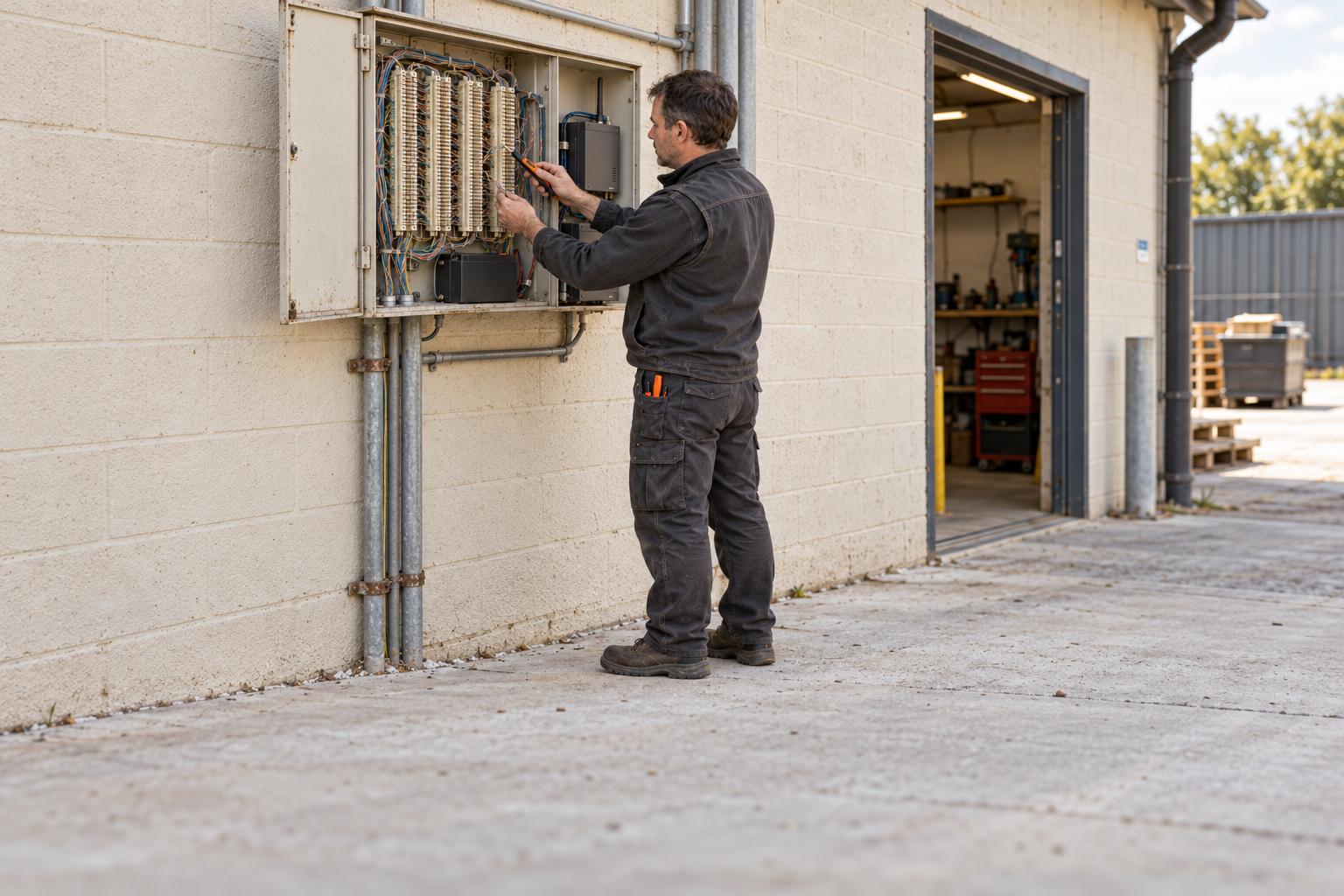
Start with the invoice, not the reception desk. Request a complete list of telephone numbers, account identifiers, circuit descriptions, service addresses, and recurring charges from the carrier. Then trace each number to the physical endpoint: phone handset, fax machine, alarm panel, elevator controller, gate box, payment terminal, modem, or unknown jack. A line that nobody remembers may still be connected to equipment that dials only during a fault or scheduled test. The FCC's reporting definitions make this plausible by explicitly including fax and dial-up connections among fixed-voice lines. [1]
For each endpoint, record whether it receives human calls, places machine calls, or both. Find the party responsible for it: an alarm-monitoring company, elevator service firm, property manager, equipment reseller, or the business itself. Obtain the device model and the service contract, because the product's current support policy may be narrower than a generic VoIP sales claim. For example, DoorKing says third-party VoIP compatibility for its entry systems is not guaranteed. [16]
Table 1 is a printable line inventory. Copy one row per billed number or circuit. The final two columns are completion evidence, not purchasing preferences.
| Number / circuit and bill | Connected device and purpose | Maintainer / owner | Proposed path | Specialist and test / date |
|---|---|---|---|---|
| Number: ______ Carrier/account: ______ Monthly bill: ______ | Jack/location: ______ Model: ______ Inbound human call, machine signaling, or both: ______ | Contract and contact: ______ | Keep, port, replace separately, or investigate: ______ | Person who signs off: ______ Observed incoming and outgoing test: ______ Date: ______ |
| Number: ______ Carrier/account: ______ Monthly bill: ______ | Jack/location: ______ Model: ______ Inbound human call, machine signaling, or both: ______ | Contract and contact: ______ | Keep, port, replace separately, or investigate: ______ | Person who signs off: ______ Observed incoming and outgoing test: ______ Date: ______ |
| Number: ______ Carrier/account: ______ Monthly bill: ______ | Jack/location: ______ Model: ______ Inbound human call, machine signaling, or both: ______ | Contract and contact: ______ | Keep, port, replace separately, or investigate: ______ | Person who signs off: ______ Observed incoming and outgoing test: ______ Date: ______ |
The table makes an unknown line a task rather than a candidate for cancellation. Ask the carrier to identify what the circuit is provisioned to do, use an authorized technician to trace the wiring, and ask a monitoring company whether it sees that number in its account records. The physical trace and the specialist's test should agree before a row is marked complete. If several devices share one line, document each device because a successful voice call does not establish that all attached equipment can signal.
A useful site walk also records power and network dependencies. A Massachusetts state consumer guide notes that fiber telephone service uses an optical network terminal requiring local power; California's utility regulator says VoIP availability during an outage depends on the underlying facility. For equipment that must work during an outage, ask for the complete backup-power design and test it under the applicable standard rather than relying on the word “digital.” [17] [18]
The physical trace and the specialist's test should agree before a row is marked complete. If several devices share one line, document each device because a successful voice call does not establish that all attached equipment can signal.
Triage: Match the Line to a Replacement Category
- Check number eligibility, call flow, and emergency-calling arrangements before selecting cloud routing or carrier voice.
- Test menu options, busy and no-answer paths, after-hours routing, voicemail, and call-back behavior from outside numbers.
- The office owner signs off after actual staff answer.
- Have the device maker, monitoring company, elevator contractor, or qualified specialist establish compatibility and acceptance.
- Record transmitted signals, the receiving station, backup power or link-loss behavior, and local approval where required.
- Test each device separately; a successful human call does not validate equipment signaling.
A mixed-use line should be split into separate projects or retained until a qualified contractor validates every use.
The first purchase decision is whether the circuit carries customer voice or device signaling. A number can be portable and still be unsuitable for a voice-only destination if the old circuit also feeds a device. A mixed-use line should be split into separate projects or retained until a qualified contractor validates every use. The primary table below compares route categories and names the person whose acceptance matters.
Table 2 shows where an ordinary mobile-routed business number belongs alongside equipment-specific replacements. Its service examples are not claims of compatibility with an untested device.
| Existing line / proposed route | Suitable when | Required owner, specialist, and acceptance test |
|---|---|---|
| Customer calls: autoattendant.io inbound routing | The number is used for inbound human calls. The service advertises one local or toll-free number, a menu of up to nine options, and routing to team members' existing mobiles for $29 per month for the company. It has no analog device connection or outbound calling. | Office manager confirms port eligibility, greeting, each menu option, simultaneous or sequential ring, after-hours path, voicemail, and calls from outside networks. Check emergency-calling needs separately. |
| Customer calls: carrier voice or VoIP line | Desk handsets or outbound office calling are needed; obtain the actual provider's equipment and 911 terms. A current AT&T business offer advertises up to six lines at $15 per line monthly when bundled with AT&T Business Fiber, plus taxes and fees. Availability is limited; confirm address availability and eligibility for the new-fiber offer in a written quote. Budget any incremental broadband subscription cost separately. [19] | Telecom provider and office owner test inbound, outbound, caller ID, voicemail, 911 location and power behavior as applicable. |
| Fax: device-specific fax service or approved digital workflow | Document exchange requirements permit a hosted fax path, or the device maker and provider support an analog adapter or fax-over-IP path. Brother does not guarantee all fax-over-VoIP results; T.38 is an ITU fax-over-IP recommendation. [4] (Source: www.itu.int) | Office or records owner and fax vendor send and receive representative documents, including long or multi-page samples, before retiring the line. |
| Fire or monitored security alarm: listed communicator or monitored replacement | The panel, communicator, monitoring agreement, backup power, and local approval fit the proposed path. A generic voice-forwarding number is not a signaling circuit. [2] | Qualified alarm contractor, monitoring station, and local AHJ where required verify signals, trouble conditions, supervision, power, and documentation. |
| Elevator emergency phone: approved elevator communications path | The elevator maintainer and AHJ approve the exact equipment and communication route. [3] [20] | Elevator contractor and authority verify the emergency connection, location, callback or monitoring arrangement, periodic tests, and backup power. |
| Gate, intercom, payment terminal, or other dialer: maker-approved path | The exact model supports the chosen voice, cellular, Ethernet, or Wi-Fi path. A DoorKing legacy modem path, for example, does not work over cellular or VoIP. [16] [21] | Device vendor or service contractor tests entry, remote programming, transaction or signal flow, and failure behavior. |
| Unknown use: hold and investigate | No one can yet identify the endpoint or maintenance agreement. | Carrier and authorized site technician trace the circuit; do not port or disconnect until purpose is documented. |
The autoattendant.io row is a direct-provider example for the ordinary inbound voice category. Its emergency-calling page states the service does not place outbound calls or provide 911/E911, so it is inappropriate as an analog, alarm, fax, or elevator replacement. That operational limit should be checked against the business's call needs before any port.
The table also separates “wireless” from “automatically acceptable.” UL says fire-alarm dialer capture modules require compatibility with the installed dialer and that simply converting communication does not establish compliance. Schindler makes its wireless elevator offering contingent on local AHJ approval. Device-specific evidence and a signed test are more useful than a generic promise that a line can be converted. [2]
Device-Specific Checks and Sign-Off
Fax and document workflows
To replace a fax line without copper, first decide whether the business needs to keep the physical fax machine, the existing fax number, or only the ability to exchange documents. These are different requirements. If the machine remains, obtain its maker's instructions and the provider's written support for the chosen adapter or fax service. T.38 is an International Telecommunication Union (ITU) recommendation for real-time Group 3 fax over Internet Protocol, but citing the standard alone does not prove a particular device and network combination will work. Brother recommends checking the provider's G.711 setting in its relevant VoIP guidance and running an inbound test fax. (Source: www.itu.int) [4]
The acceptance test should use the actual documents and destinations the business relies on, including outgoing and incoming pages, confirmation reports, and the records workflow. Where documents contain patient or customer information, the business should evaluate its own records and privacy requirements with the prospective service. A failed test means the old fax circuit stays until another path is approved. A successful one should be recorded with the date, destination, and person who received it.
Fire and security alarms
An alarm's telephone-looking cable may be carrying data from a digital alarm communicator transmitter (DACT), not a normal conversation. UL describes dialer-capture modules that can move signaling to cellular or Ethernet/IP, yet says conversion alone does not establish compliance. It highlights dialer compatibility, standby power, and a local trouble signal if transmission fails. These are system requirements, not features supplied by a normal business number. [2]
Ask the alarm contractor for the permitted communication path for the specific panel, a written quotation that includes monitoring and installation, and a witnessed end-to-end test with the monitoring station. For a security system, arrange the monitoring company's test mode under its procedure so a test does not trigger an unnecessary response; Alarm.com documents a mode in which the monitoring station does not respond to test alarms. A compatible security module may use cellular and broadband paths, but its actual configuration still needs verification. Fire-alarm changes may require local design review or permit sign-off; one district's checklist asks for communication type and a signed plan. [22] [23] [13]
Elevator, gate, and payment equipment
An elevator emergency device must connect a trapped person with the authorized party responsible for assistance; the U.S. Access Board describes that communication purpose in its elevator guidance. Schindler's wireless example lists phone-line tests, self-checks, and emergency power, while making installation contingent on AHJ approval. The elevator service contractor should identify the exact applicable code edition and the entity that accepts the replacement at that building. A normal call forwarded to an owner's mobile is not a substitute for that review. [20] [3]
A gate or intercom may support ordinary voice yet have a separate modem or remote-programming path. DoorKing says some older systems require a board upgrade for its cellular option and that its IM Server modem communication will not work over cellular or VoIP. The gate maintainer must test visitor calls, remote release, programming, and loss-of-link behavior for the actual model. Similarly, a payment terminal may have an Ethernet or Wi-Fi option, as Ingenico describes for compatible devices, but the processor or terminal provider must confirm the supported path and transactions. [16] [21]
Migration Sequence and Continuity Tests
- 01Inventory and classify
Trace every billed number to its physical endpoint and identify whether it carries customer voice, device signaling, or both.
- 02Read the carrier notice
Record the affected account and numbers, proposed change, deadline, replacement, and contact for questions or disputes.
- 03Confirm eligibility and port data
Have the gaining provider check each number. Copy the account holder, service address, account number, and any transfer PIN from current records.
- 04Maintain service overlap
Keep the prior service active until the move completes and include overlap in the budget.
- 05Test calls and devices
Test customer routing and each device separately, documenting staff response, specialist results, power behavior, and required approvals.
- 06Close proven unnecessary circuits
After the port and specialist tests succeed, obtain written confirmation of retained circuits and charges that will end.
Document successful porting and specialist tests before closing old service.
Keep an unknown line under investigation. A failed fax test means the old fax circuit stays until another path is approved.
A safe migration is two tracks: customer calling and equipment signaling. The voice track can proceed only after the inventory shows that the number is not also a machine's transmission path. If a shared number must be kept for a device, ask the current carrier and prospective provider what can be ported or reassigned without disabling that device. There is no universal answer for a multi-line account, so the account-specific order must be documented before it is submitted.
- Read the notice. Record the sending carrier, affected account and numbers, exact proposed change, deadline, proposed replacement, and contact for disputes or questions. The FCC order does not supply a common customer shutoff date. [5]
- Confirm eligibility. Ask the gaining provider to check each number, including geographic and account limits; Verizon's business guidance says eligibility can depend on geography, coverage, technology, or ownership. [9]
- Prepare port data. Copy the legal account holder, service address, account number, and any transfer PIN from the recent bill or carrier record. AT&T says inaccurate details can delay processing. [10] [9]
- Keep the old account active. Both Verizon and T-Mobile tell customers to maintain the prior service until the move completes. Schedule overlap in the budget. [11]
- Test customer routing. From unrelated mobile and landline numbers, call the public number; try every menu option, busy and no-answer paths, after-hours routing, voicemail, and call-back behavior. The office owner signs off only after actual staff answer.
- Test every device separately. The specialist records transmitted signals, receiving station, backup power or link-loss behavior, and local approval where required. A successful human call is not a fire-alarm, elevator, fax, or modem test. [2]
- Close the old service deliberately. After the port and specialist tests succeed, obtain written confirmation of which circuits remain and which recurring charges will end. California's consumer number-transfer guidance likewise says to arrange the move before canceling old service. [24]
Number portability is regulated, but a regulatory interval is not an end-to-end promise for a complicated business account. The FCC's one-business-day interval applies to defined simple wireline-to-wireline and intermodal requests, with conditions. Current carrier guidance illustrates the range an owner may encounter: Verizon estimates 2 to 10 business days for a landline transfer into its mobile service, AT&T states a 5 to 7 business day minimum for a non-wireless transfer, and T-Mobile gives 3 to 10 days for landline transfer. Ask the gaining provider for the actual due date, account requirements, and a rollback contact. [25] [9] [10] [11]
Emergency calling is a separate acceptance item. The National 911 Program says test calls should be arranged through a local 911 center's non-emergency number to confirm routing and location; it also advises VoIP users to keep the registered physical location current. For the inbound-only mobile-routing example in Table 2, the product says it does not originate 911 calls, so workers' own mobile carriers carry their outbound emergency calls. A business replacing an office phone system should ask its chosen voice provider and qualified adviser what emergency-calling setup applies to that system and location. [26]
Data Analysis and Evidence
The FCC's fixed-voice data for June 2025 counted 15 million U.S. switched access lines, 63 million interconnected VoIP subscriptions, and 395 million mobile subscriptions. Its business fixed-voice table listed about 8.612 million business switched access lines and 43.972 million business interconnected VoIP subscriptions. Those are national service categories, not a count of small-business copper circuits about to be shut off; the report says switched access lines had declined at a 17.9% compound annual rate during the preceding three years. The directional lesson is migration activity, not a deadline or price for a particular address. [27]
Price evidence is narrower. As of October 3, 2026, autoattendant.io advertises $29 per month for a single local or toll-free business number and menu for the company, with unlimited people receiving routed calls. An AT&T business voice offer advertises up to six lines at $15 per line monthly when bundled with AT&T Business Fiber, plus taxes and fees. Availability is limited; confirm address availability and eligibility for the new-fiber offer in a written quote. Include any incremental broadband subscription cost in the twelve-month comparison. These are different services and cannot be treated as interchangeable with an analog alarm or elevator circuit. More importantly, neither advertised figure is the owner's total cost after hardware, installation, monitoring, testing, taxes, or retained legacy service. [19]
Table 3 supplies a twelve-month owner-input comparison. Enter written figures for each inventory row. The model makes one-time conversion costs visible without assigning a fictional dollar value to service risk.
| Input for each line | Keep current circuit | Replace circuit or customer-call path |
|---|---|---|
| Monthly circuit or service charge | Current invoice: $_____ | Written new quote: $_____ |
| Monthly monitoring or related subscription | Existing contract: $_____ | New monitoring or service: $_____ |
| Monthly broadband subscription cost attributable to this option | Current attributable broadband cost: $_____ | New attributable broadband cost, including any incremental bundle requirement: $_____ |
| Hardware, adapter, or battery | Required current repair: $_____ | Quoted equipment and power: $_____ |
| Installation and configuration | Current work order: $_____ | Contractor's installation: $_____ |
| Testing, inspection, or approval | Current recurring test: $_____ | Migration acceptance and retest: $_____ |
| Overlap, port, taxes, and fees | Expected current charges: $_____ | Itemized quote or expected overlap: $_____ |
| Twelve-month total | 12 × monthly items + one-time items | 12 × monthly items + one-time items |
The model separates cost from risk. In a note beside each row, record the outage path, any battery maintenance, who answers an emergency device, the cost of a failed acceptance test, and any dependency on broadband or mobile coverage. Maine's commission asks carriers specifically about replacement equipment and old-versus-new service cost; Massachusetts advises reviewing the bill after a copper-to-fiber change. Those public checklists support asking for complete written pricing rather than comparing headline rates. [12] [17]
The owner's decision rule is simple: buy the least costly suitable route that meets the documented call or device requirement, then maintain overlap until tests pass. For a voice line, that may be a number and routing menu. For a monitored device, the responsible contractor's compatible communicator, power design, monitoring fee, and acceptance work belong in the same calculation. A zero in an equipment cell is justified only when the vendor and tester confirm no such item is needed.
Implications and Future Directions
A firm receiving a carrier notice should respond with its line inventory, not a request for a generic VoIP quote. Ask the carrier which numbers and services the notice covers, the intended network or retail-service change, what happens to any analog port, whether the number can be retained, and how long the current circuit will be supported. Where the notice is unclear, request a corrected written account-level description. This matters because the FCC's network-change procedure does not create a universal direct end-user notice, and a retail-service discontinuance can involve a separate authorization path. [5]
The owner should also identify the jurisdiction. State utility protections vary: Minnesota has a customer transition-plan statute in qualifying cases and is still evaluating its interaction with FCC 26-19; Maine's regulator asks carriers about customer equipment and cost; New York has a covered transition notice framework. Local fire and elevator officials determine relevant approval details for their facilities. These examples are prompts for the owner's state and local check, not national rules. [7] [12] [15]
Technology choices will continue to change, but the line-purpose test remains stable. VoIP or fiber can be appropriate for human calls yet depend on local power; cellular or IP signaling can be suitable for a listed alarm communicator but only with verified panel compatibility and monitoring. California's utility regulator says VoIP outage behavior depends on its underlying facility, while UL describes standby power and compatibility as part of fire-alarm communicator evaluation. A small firm should update the inventory when it adds equipment, changes carriers, or moves offices. [18] [2]
Frequently Asked Questions (FAQs)
Can an alarm system use a VoIP phone line?
Sometimes a specific panel and communicator can use an approved Internet Protocol path, but a generic voice line or analog telephone adapter should not be assumed suitable. UL says a dialer capture module requires compatibility with the DACT and that merely converting the communication device does not establish compliance. The alarm contractor and monitoring station should specify the supported path, power reserve, supervision, and witnessed test; local fire authority approval may apply. [2] [13]
How can a business replace a fax line without copper?
Choose between keeping the machine on a provider-supported connection and replacing the workflow with a hosted fax or another approved document exchange. Preserve the advertised fax number if needed, ask the maker and provider about the exact device and protocol, and send and receive real test documents before disconnecting copper. T.38 defines a fax-over-IP method, but Brother's guidance does not guarantee fax transmission over VoIP for its covered devices. (Source: www.itu.int) [4]
Does an elevator phone work with a cloud business number?
An inbound auto-attendant menu is not an elevator emergency communication system. The elevator maintainer must specify the permitted device and communication path, and the local AHJ may need to approve it. U.S. accessibility guidance describes a system that directly connects to authorized personnel; a wireless elevator-phone provider also identifies regular tests, self-checks, emergency power, and local code approval. [20] [3]
Can a landline business number be ported to a mobile-routed service?
Often, if the gaining provider confirms eligibility and the number is not needed by an attached device. The owner should copy exact account data from the current bill and leave the old account active until the port completes. The FCC's simple-port interval is narrower than the total time many carriers quote for a landline transfer; estimates differ by provider and account, so obtain a scheduled due date rather than promising one. [8] [25]
What if the carrier's notice names several lines or an unknown number?
Treat each number as a separate inventory row, map it to the endpoint, and have the relevant maintainer confirm its function. Do not cancel a mystery circuit because it appears unused in the office. Ask the carrier which exact service changes, which charges continue, whether an affected device needs new equipment, and what help applies in the state. Maine's regulator asks those equipment, cost, and notification questions of retiring carriers; Minnesota provides a state example of transition assistance in covered cases. [12] [14]
Conclusion
A business replaces copper lines safely by sorting calls from devices before selecting products. The customer-call number may fit a cloud-routed menu, a mobile service, or another voice provider after eligibility and routing tests. Fax, alarm, elevator, gate, payment, and unknown lines require separate evaluation against the actual device, monitoring arrangement, power design, and local approval. The inventory and matrix make those decisions visible to the owner and to the specialists who must accept the work.
The March 2026 FCC order changes the carrier transition process, but it does not give every business the same shutoff date or displace the need to inspect a particular carrier notice and state rules. The practical sequence is to identify each billed circuit, obtain written replacement quotes, keep old service during any port and device tests, document sign-off, and then close only the circuits proven unnecessary. The twelve-month worksheet turns that sequence into a cost decision without treating an advertised voice price as the cost of a complete equipment migration. [5] [8] [12]
External Sources (27)
Published by
Auto Attendant Editorial
Auto Attendant gives a small business one phone number and a recorded menu that sends each caller to the right person's mobile, for a flat $29 a month per business line, whatever the size of the team.
Editorial note
Researched and written by Auto Attendant Editorial with AI-assisted research tools; sources are cited inline and checked before publication. Report an error: https://autoattendant.io/contact/.