The two products in one sentence
Auto Attendant: one business number, a spoken menu of up to seven options, and forwarding to existing mobiles for $29/month for the company. It handles incoming calls, including a closed message after hours and voicemail by email, but does not place outgoing calls, send texts, record conversations or provide desk phones or apps.
Grasshopper: Grasshopper is a virtual phone service priced per account, with apps, texting and business caller ID for outgoing calls alongside its phone menu.
What the vendor publishes
Menu-plan price: Solo Plus: $25/month for 3 extensions; billed annually.1
Is an installed app required to take calls? Not for forwarded calls; apps are offered.2
Solo Plus is $25/month billed annually or $32/month billed monthly, for the whole account, with unlimited users, one number and three extensions; extra extensions are $3/month each on annual billing. True Solo has one user and one extension.1
The pricing page’s feature table shows Interactive Voice Response (IVR) on Solo Plus and Small Business, not on True Solo, so Solo Plus is the lowest plan with a phone menu.1
Grasshopper lists a phone menu, mobile and desktop apps, forwarding, business hours and call recording among its core features.2
Simultaneous ringing is the Call Blasting add-on, $9/month, which rings each line at the same time.3
Grasshopper lets you forward calls to a cell phone or landline, choose which number receives calls at what time of day, and port an existing business number for free.4
Grasshopper offers local numbers, vanity numbers and toll-free numbers in the 833, 844, 855, 866, 877, 888 and 800 codes.5
What one, three, five and seven people cost
The menu-capable plan used here is Solo Plus: $25 per month for 3 extensions, billed annually; $3 per extra extension.1 These are subscription examples in USD, before any applicable taxes, fees or separately charged usage. Our $29 is billed monthly; an annual-billing figure is a monthly equivalent of a longer commitment.
| People receiving calls | Grasshopper monthly equivalent | Auto Attendant monthly |
|---|---|---|
| 1 | $25 ($25) | $29 |
| 3 | $25 ($25) | $29 |
| 5 | $31 ($25 + 2 × $3) | $29 |
| 7 | $37 ($25 + 4 × $3) | $29 |
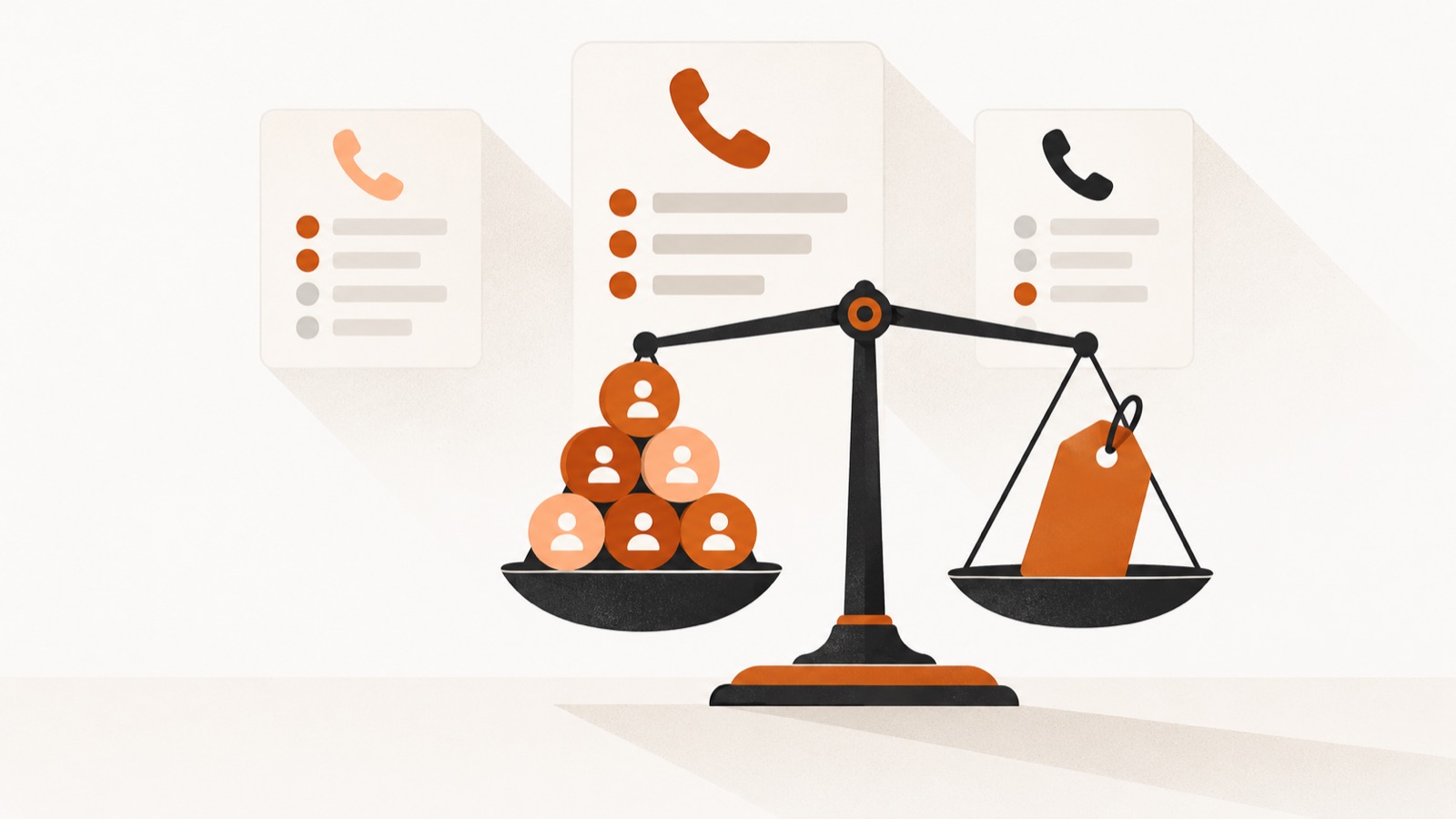
At 5 people, this published plan first exceeds $29/month on the stated billing basis. This is a price crossover, not a claim that the products provide the same functions.
Auto Attendant has no per-person charge: its up to seven menu options each ring up to three phones in turn, so the same $29 covers every person who answers.
Solo Plus is priced per account, not per person: users are unlimited, and the figures here assume one extension for each person a menu option rings (three included, then $3/month each on annual billing). Ringing several phones at once is the $9/month Call Blasting add-on, not included above.
How a call reaches your team: Grasshopper and Auto Attendant
The practical difference is where the work happens. With Auto Attendant, a caller dials one business number, hears a spoken menu, presses a key and the call rings the chosen person's own mobile (or up to three phones in turn) as an ordinary incoming call showing the business number; nobody installs an app, and the team keeps its existing mobile plans. How it works shows the whole path, and the auto attendant and IVR glossary entries separate a simple keypad menu from a full interactive voice response system.
- Who answers: on whether Grasshopper needs an installed app to take calls, the cited source says: not for forwarded calls; apps are offered.2 Auto Attendant rings the phones people already carry.
- How it is billed: Grasshopper prices the cited plan as a monthly bundle of included extensions with extra extensions added on top.1 Auto Attendant is one $29 monthly charge for the company.
- What the menu can do: compare the routing options in the facts above with the call routing Auto Attendant offers; Grasshopper's tools may be broader, and the question is whether you will configure and pay for the extra breadth.
- What Auto Attendant leaves out: it handles incoming calls only, so it does not place outgoing calls, send or receive texts, record conversations, ring several phones at once or provide queues; those belong to full platforms such as Grasshopper, compared in general on auto attendant vs VoIP platforms.
Questions to ask Grasshopper before you buy
Plan names and entitlements change often, so treat the page you read as a snapshot and put these questions to Grasshopper before you sign. The answers decide whether the comparison on this page still holds.
- Which plan includes the phone menu, and is the quote for that plan? Solo Plus is priced per account, not per person: users are unlimited, and the figures here assume one extension for each person a menu option rings (three included, then $3/month each on annual billing). Ringing several phones at once is the $9/month Call Blasting add-on, not included above.
- Does every person who answers a call need a paid seat? Ask how the plan counts users, extensions and shared numbers, because that count drives the bill.
- What is the billing basis? The figure used here is billed annually; ask what the monthly-billing price is and whether the term auto-renews. Taxes, regulatory fees and any usage charges are normally extra.
- What happens when nobody answers? Test the fallback: a menu option that rings a mobile in a no-signal area should fall through to voicemail, not to a busy tone. The no-answer timeout and overflow entries define the terms, and the call queue and ring group guide shows an all-busy test.
- How is the existing number moved? Ask for the porting steps, the information you must supply and the expected interval; the rules below set the minimum for ordinary numbers.8 Our porting guide lists what to collect first.
- How is each user's emergency address set? See the checks below and our emergency calling page before putting any phone service in front of staff.
Emergency calling and number porting checks
Two federal rules apply to any phone service you buy, so ask Grasshopper how it meets them. First, emergency calls. Kari's Law requires a multi-line telephone system to be configured so that a user can dial 911 directly, without a prefix such as the digit 9, and to provide on-site notification of the call where the system can be configured to do so.6 The FCC's definition of a multi-line telephone system covers network and premises-based systems, including Centrex, VoIP and PBX, and defines a dispatchable location as the validated street address of the calling party plus the suite or similar detail needed to identify where they are.7 A hosted phone with several users is therefore a system to check for these points, whichever vendor it comes from. See the E911, MLTS and dispatchable location glossary entries.
Second, porting. Carriers required to port numbers must complete a simple wireline-to-wireline or intermodal port within one business day, and a non-simple port within four business days, unless the new provider or the customer asks for longer; ports involving interconnected VoIP service count as intermodal.8 That is a ceiling on carrier delay for ordinary numbers, not a promise about Grasshopper's own onboarding, so ask for the vendor's expected date in writing. Read the local number portability and letter of authorization definitions, and the porting-time article for realistic intervals.
What the flat $29 line gives you
Auto Attendant has no annual billing basis and no per-extension charge: $29 a month covers a menu of up to seven options, each ringing up to three existing mobiles in turn. Calls ring as ordinary incoming calls; people use their own mobile plan and dialler, and nobody needs a seat or an app. You pick the number, write the menu in English, French or Spanish (or up to all three) and set business hours online in the app. Voicemails arrive by email with the MP3 attached, and the transcript follows in a second email, in the voicemail's own language. See the complete call path and the $29 plan.
Further reading
Longer research pieces on this topic, each with its own source list and a downloadable PDF.
Articles on this topic
Topics VoIP Small business phone system Zoom Phone All topics
Sources
Every regulatory and pricing claim on this page links to the primary source it came from. Figures were checked on the date shown at the top of the page; rules and prices change, so verify before relying on one.
- Grasshopper: Solo Plus is $25/month billed annually or $32/month billed monthly, for the whole account, with unlimited users, one number and three extensions; extra extensions are $3/month each on annual billing. True Solo has one user and one extension. Retrieved 26 Oct 2026
https://grasshopper.com/pricing - Grasshopper: Grasshopper lists a phone menu, mobile and desktop apps, forwarding, business hours and call recording among its core features. Retrieved 14 Oct 2026
https://grasshopper.com/about-us - Grasshopper: Simultaneous ringing is the Call Blasting add-on, $9/month, which rings each line at the same time. Retrieved 26 Oct 2026
https://grasshopper.com/features/add-ons - Grasshopper: Grasshopper lets you forward calls to a cell phone or landline, choose which number receives calls at what time of day, and port an existing business number for free. Retrieved 14 Oct 2026
https://grasshopper.com/features/call-forwarding - Grasshopper: Grasshopper offers local numbers, vanity numbers and toll-free numbers in the 833, 844, 855, 866, 877, 888 and 800 codes. Retrieved 14 Oct 2026
https://grasshopper.com/faq - Kari's Law Act of 2017, Public Law 115-127 (direct 911 dialing from multi-line telephone systems and on-site notification). Enacted 16 February 2018
https://www.congress.gov/115/plaws/publ127/PLAW-115publ127.pdf - 47 CFR § 9.3, Definitions (multi-line telephone system, dispatchable location). Retrieved 14 Oct 2026
https://www.law.cornell.edu/cfr/text/47/9.3 - 47 CFR § 52.35, Porting intervals (one business day for a simple port, four for a non-simple port). Retrieved 14 Oct 2026
https://www.law.cornell.edu/cfr/text/47/52.35