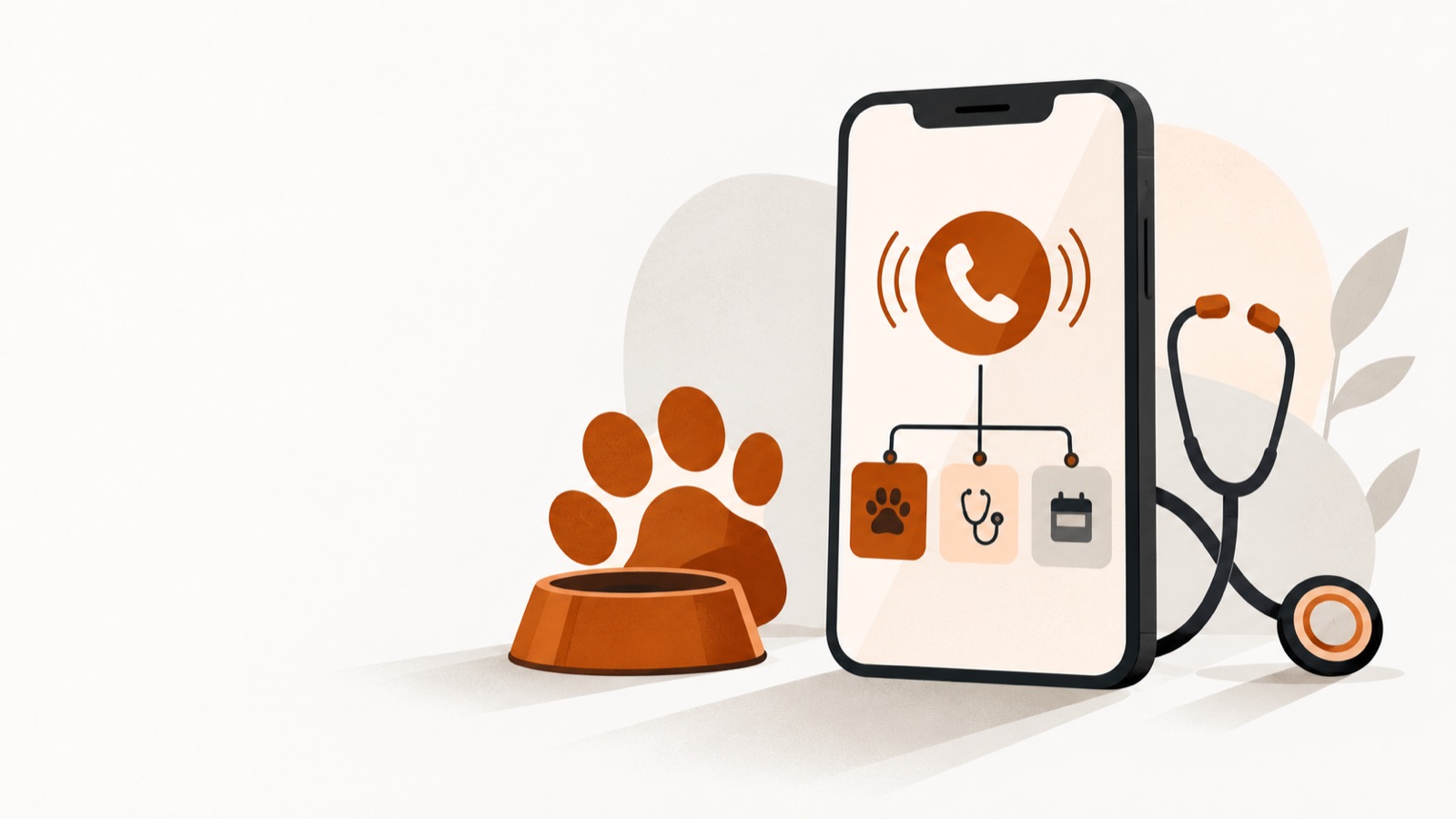
Who is calling, and what do they need?
Pet owners call to book routine visits, ask about an existing patient, or seek help when an animal is unwell. The urgent route should lead only to a person who can respond under the clinic’s actual coverage plan.
Keep the top-level menu in the caller’s language. In Auto Attendant each option does one thing: it rings up to three phones one after another (each for 10 to 60 seconds, never together), takes a voicemail, or plays a message and hangs up. Point each option at the person, or the shared phone, that actually handles this call, and add a backup only where a missed call costs you.
How veterinary clinic calls actually go
Veterinary callers are often anxious in a way a billing caller is not. An owner whose dog has eaten something or whose cat is straining wants a person quickly, and the greeting has to tell them truthfully whether that person exists right now. Routine calls (vaccines, refills, booking a dental cleaning) are much more forgiving and can wait for a voicemail.
The key design decision is the closed-hours message. Many clinics refer after-hours emergencies to a 24-hour hospital. If yours does, name the hospital and read its number slowly in the greeting; do not send callers to a voicemail box that will not be checked until morning. If the clinic’s own vet takes after-hours calls, either keep the menu open for those hours so the urgent option rings that vet’s phone, or give the on-call arrangement in the closed message; Auto Attendant does not forward calls once the closed message plays.
Recommended menu
| Caller’s choice | Role to ring | What it does | Why this route |
|---|---|---|---|
| 1. Routine appointments | reception mobile | Rings one phone | A shared reception mobile lets whoever is at the desk begin a routine booking. |
| 2. Existing patient or follow-up | clinic coordinator | Rings one phone | One coordinator can direct the caller after answering. |
| 3. Urgent concern during staffed hours | clinical team lead, then second vet | Rings up to 3 phones in turn, then voicemail | The team lead rings first and a second vet next, so the urgent instruction stays unambiguous and a missed call is rare. |
Scroll the table sideways to see every column.
Shaded text is a fill-in field: replace it with your own.
This example uses 3 menu options. Auto Attendant allows up to seven; add an option only when it sends a distinct kind of caller to a meaningfully different destination. A call that rings every phone you listed without an answer goes to voicemail. The menu can be in English, French or Spanish, and a line can also skip the menu and go straight to one action.
Greeting script
Business name. For routine appointments, press 1. For an existing patient or follow-up, press 2. For an urgent concern during staffed hours, press 3.
Shaded text is a fill-in field: replace it with your own.
24 words, about 10 seconds spoken at 150 words per minute. The estimate is calculated from the script above; allow extra time for pauses and clear delivery.
Read each reason before its key, as in “For a new enquiry, press 1”. Replace the shaded fields and any role or service wording before you type the greeting into the menu; a text-to-speech voice reads it to callers.
A worked example
Illustration: a two-vet clinic offers 1 for routine appointments, 2 for existing patients and 3 for urgent concerns during staffed hours. Outside those hours, the greeting says: “We are closed. For an emergency, contact [emergency hospital] on [number]. For poison concerns, a national poison helpline such as the ASPCA’s is available around the clock.” The ASPCA lists its helpline on its Animal Poison Control page 1, which also notes that a consultation fee may apply, so check the current terms before quoting anything to callers.
What goes wrong is vagueness: “If your pet has an emergency, please leave a message.” That sentence invites the worst-case call into a mailbox. If the clinic cannot answer, the honest message is one that sends the caller elsewhere in the first ten seconds.
After hours, weekends, and holidays
Say whether the clinic is closed and give the next opening time. If an emergency hospital or on-call clinician is part of the clinic’s approved plan, state that route precisely; otherwise direct callers to the clinic’s published emergency instructions.
Confirm which location, if any, is open and who is covering. Replace the usual message with the holiday plan rather than assuming weekday coverage applies.
Outside the hours you set, Auto Attendant plays your closed message and then takes a voicemail or ends the call; it does not forward calls after hours, and holidays are closed all day. Where the advice above mentions an on-call route, either keep that person’s option within your set hours or give the arrangement in the closed message.
Check the greeting after every schedule change. A voicemail arrives by email with the recording attached and a transcript when one is produced, but it does not make the call live or guarantee a response time.
Rules and standards worth knowing
Veterinary records are not covered by HIPAA, but state veterinary practice acts and clinic policy still shape what you can say about a patient, and owner contact details deserve ordinary care. Keep the greeting free of patient names and avoid describing treatments aloud.
The public-facing rules that do reach a clinic’s phone line are access rules. Businesses open to the public must communicate effectively with people with disabilities 23, and the ADA’s service animal rules limit staff to two questions when it is not obvious what task an animal performs 4. That matters when a caller asks whether a service dog may come into the waiting room; the answer should come from a policy, not improvisation.
If your team texts owners back after a missed call, the Telephone Consumer Protection Act governs consent for certain automated calls and messages 5. Auto Attendant itself places no outgoing calls or texts; this applies to what your staff do afterwards.
This is general information, not legal advice. Rules differ by state and change; confirm anything that affects your business with the source or an adviser.
Common menu mistakes
- Calling a route “emergency” when nobody is committed to answer it.
- Sending all calls to the veterinarian’s personal mobile.
- Failing to distinguish routine follow-up from urgent concerns.
Keep the greeting short, use the same names callers see elsewhere, and make sure every route has a sensible end when nobody picks up.
Check the menu before you publish it
- Verify the emergency hospital’s name, number and hours before publishing the closed message, and re-verify each season.
- Say the number twice in the closed-hours message.
- Decide who returns routine voicemail and by what time the next day.
- Write a one-line policy for service animals so reception answers consistently.
- Call at 2 a.m. and listen to the first ten seconds as a worried owner would.
Related guides and templates
- Medical clinic: phone menu guide
- Dental practice: phone menu guide
- Pest control company: phone menu guide
- After-hours greeting: call-flow template
- Holiday closure: call-flow template
- Weekend greeting: call-flow template
- Call routing and menu design
- What is an auto attendant?
- Emergency calling
- Auto attendant or answering service
Further reading
Longer research pieces on this topic, each with its own source list and a downloadable PDF.
Articles on this topic
Topics Small business phone Auto attendant Call forwarding Voicemail All topics
Sources
Every regulatory and pricing claim on this page links to the primary source it came from. Figures were checked on the date shown at the top of the page; rules and prices change, so verify before relying on one.
- ASPCA, Animal Poison Control. Retrieved 14 Oct 2026
https://www.aspca.org/pet-care/animal-poison-control - ADA.gov, ADA Requirements: Effective Communication. Retrieved 14 Oct 2026
https://www.ada.gov/resources/effective-communication/ - ADA.gov, Businesses That Are Open to the Public (Title III). Retrieved 14 Oct 2026
https://www.ada.gov/topics/title-iii/ - ADA.gov, ADA Requirements: Service Animals. Retrieved 14 Oct 2026
https://www.ada.gov/resources/service-animals-2010-requirements/ - 47 U.S.C. § 227, Restrictions on use of telephone equipment (Telephone Consumer Protection Act). Retrieved 14 Oct 2026
https://www.law.cornell.edu/uscode/text/47/227